Financial risk changes throughout the trading day. New trades, market movements and portfolio adjustments all affect exposure. To assess their impact while decisions are being made, organisations need a calculation architecture that responds efficiently to change.
A Directed Acyclic Graph (DAG) provides a way to organise these calculations so that a small change does not require the entire portfolio to be recalculated.
How Directed Acyclic Graphs (DAG) Support Incremental Recalculation
A DAG represents calculations and the dependencies between them. Position-level results feed into portfolio, desk and enterprise-wide risk measures. The structure avoids circular dependencies, allowing calculations to be updated in the required order.
When a user modifies a trade, removes a hedge or applies a hypothetical market shock, the calculation engine identifies which results depend on that change. It then recalculates the affected parts of the graph, reusing results that remain valid.
For example, removing a hedge requires the affected portfolio and its higher-level aggregations to be updated. Calculations for unrelated portfolios can remain unchanged. A broader market shock may affect more of the graph, but the same principle applies: the scope of recalculation follows the dependencies.
In the ARMS Real-Time Server, this approach is combined with in-memory risk cubes and parallel execution. Together, these components reduce unnecessary processing and make updated results available for interactive analysis.
Bring risk insight into the decision
Faster simulations allow traders, portfolio managers and risk teams to explore the consequences of a decision before implementing it. They can assess a proposed trade, compare hedging alternatives or examine how a stress scenario affects exposure while there is still time to respond.
The same calculation hierarchy connects individual positions to the wider organisation. This helps teams understand both the local impact of a change and its contribution to enterprise-wide risk.
Working from shared risk structures also supports a consistent view across trading, treasury and risk control. By reducing duplicated calculations and unnecessary recomputation, the architecture can make more efficient use of infrastructure as portfolios grow.
The result is a risk system that supports ongoing decisions throughout the trading day, alongside its reporting responsibilities.
Explore the architecture behind real-time risk
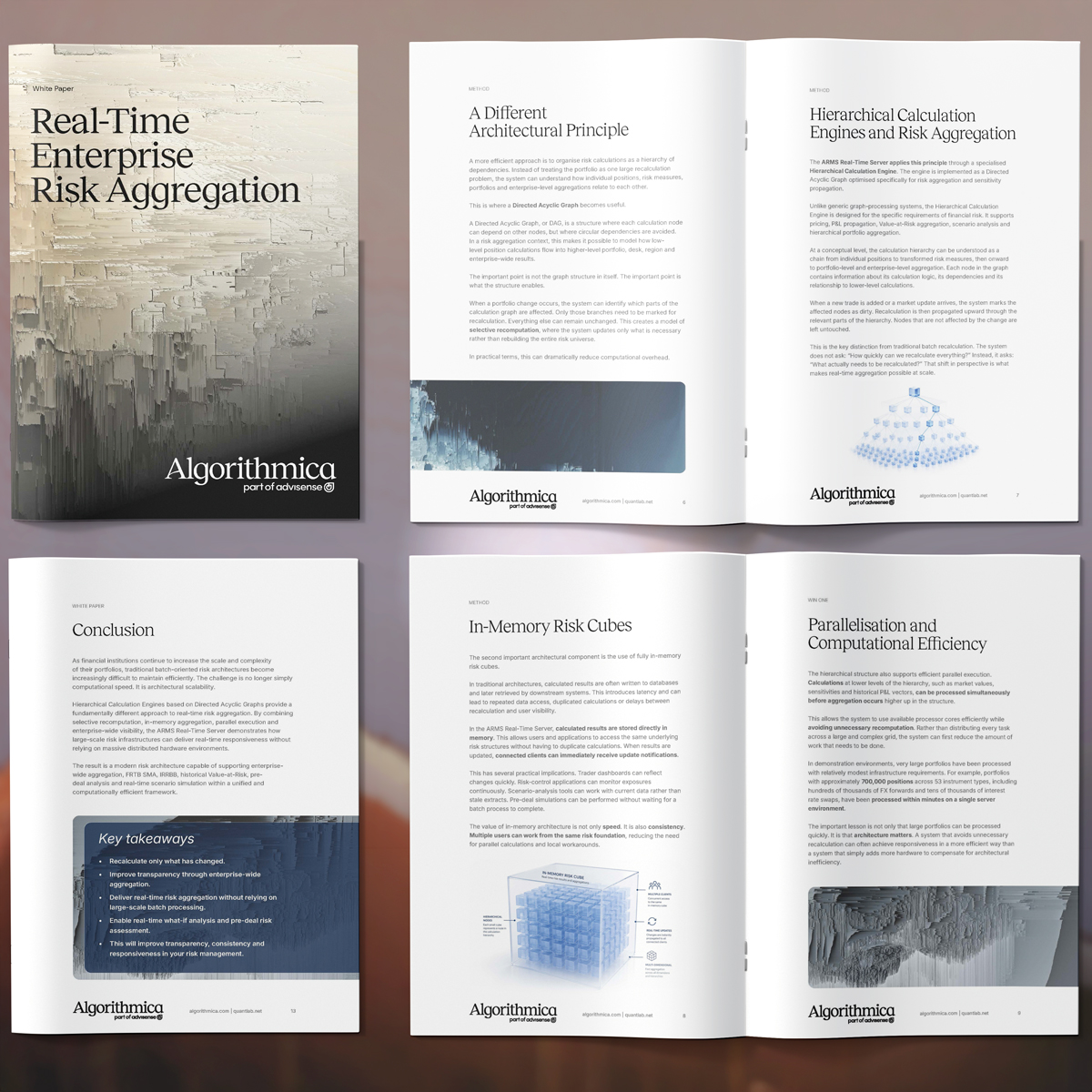
To learn more about DAG-based calculations, in-memory risk cubes and selective recalculation, download our white paper, Real-Time Enterprise Risk Aggregation.
