How Sobol Sequences Improve Monte Carlo Simulations
Monte Carlo simulations are widely used for derivatives pricing, portfolio risk analysis and other complex calculations in quantitative finance. Their flexibility makes them powerful, but they can also be computationally expensive.
What if comparable pricing accuracy could be achieved with only a fraction of the simulation paths?
Faster Monte Carlo Convergence with Sobol Sequences
Traditional Monte Carlo methods use pseudo-random numbers that may cluster in some parts of the sampling space while leaving gaps in others. This uneven coverage can result in slow convergence and require a large number of simulations to produce stable estimates.
Quasi-Monte Carlo methods instead use low-discrepancy sequences designed to cover the sampling space more evenly. Sobol sequences are one of the most widely used approaches and can significantly improve convergence in financial simulations.
Reduce Simulation Paths by a Factor of Ten
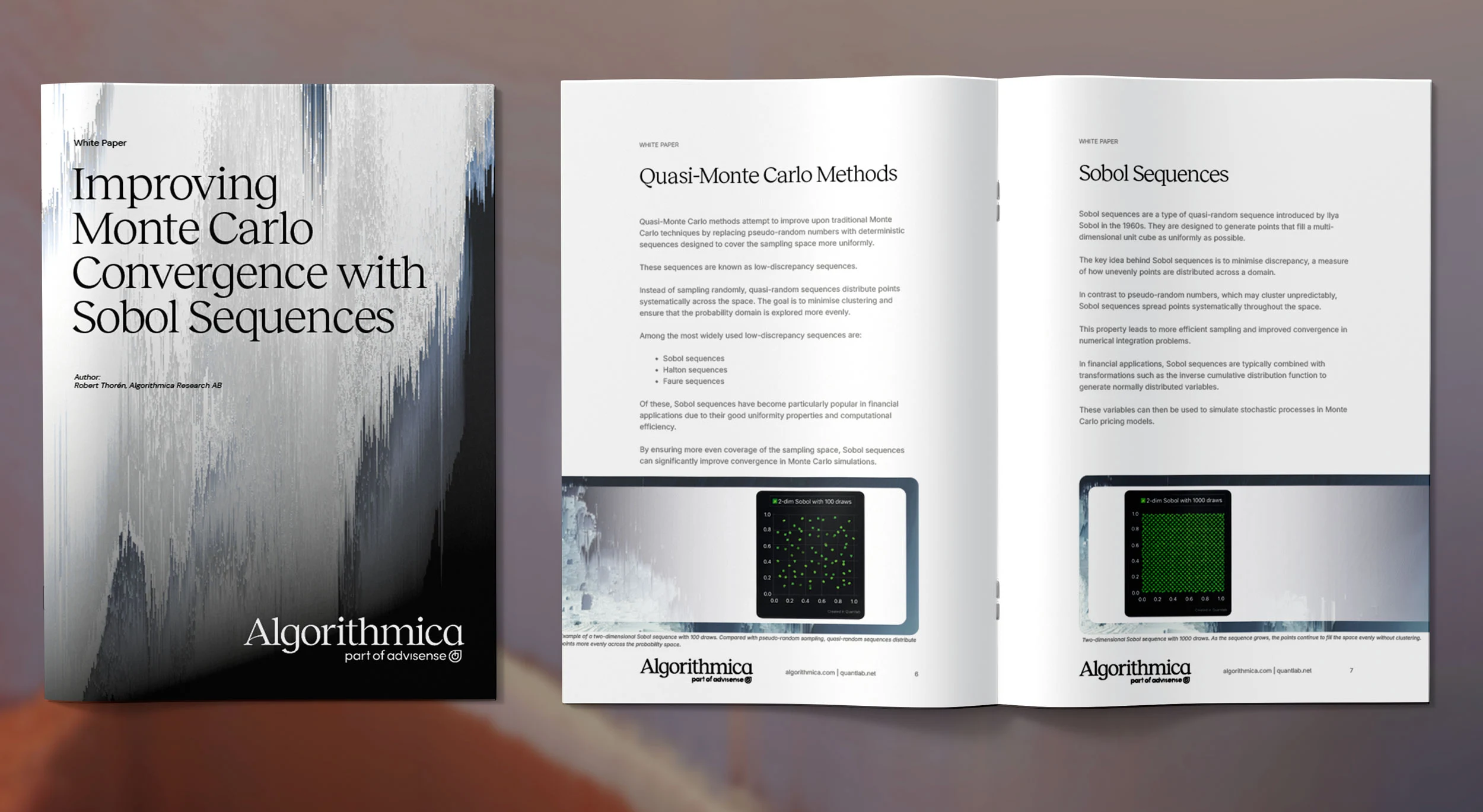
In our white paper, Improving Monte Carlo Convergence with Sobol Sequences, we compare traditional Monte Carlo simulation with a Sobol-based approach using an Asian option pricing example.
The quasi-Monte Carlo simulation achieves a pricing accuracy within approximately 0.25% using around 1,500–2,000 simulation paths. Traditional Monte Carlo requires approximately ten times as many paths to achieve similar accuracy.
More Efficient Pricing and Risk Calculations
Faster convergence can deliver tangible benefits for financial institutions:
- Faster calculations
- Lower computational requirements
- More responsive pricing and risk systems
- More efficient use of analytical infrastructure
These improvements can be particularly valuable in areas such as derivatives valuation, portfolio risk simulation, XVA calculations and real-time pricing.
Download the Monte Carlo White Paper
Download the white paper to learn how Sobol sequences can improve Monte Carlo convergence and how the method can be implemented in Quantlab.
