Real-Time Risk Systems: Why Architecture Matters More Than Hardware

The common misconception: scaling solves performance
In trading systems, performance problems are often treated as a scaling issue. Add more hardware, distribute the load, increase parallelism. Yet in practice, the real constraint is rarely computational capacity. More often, it is architectural clarity.
Where latency and instability really come from
Latency and instability do not primarily originate from a lack of processing power. They emerge from structure:
- unnecessary hops between components
- ambiguous dependencies
- unsynchronised inputs
These factors introduce friction into the system, making consistent real-time risk calculation difficult to achieve.
Real-time intraday risk at scale
This is something we have seen first-hand.
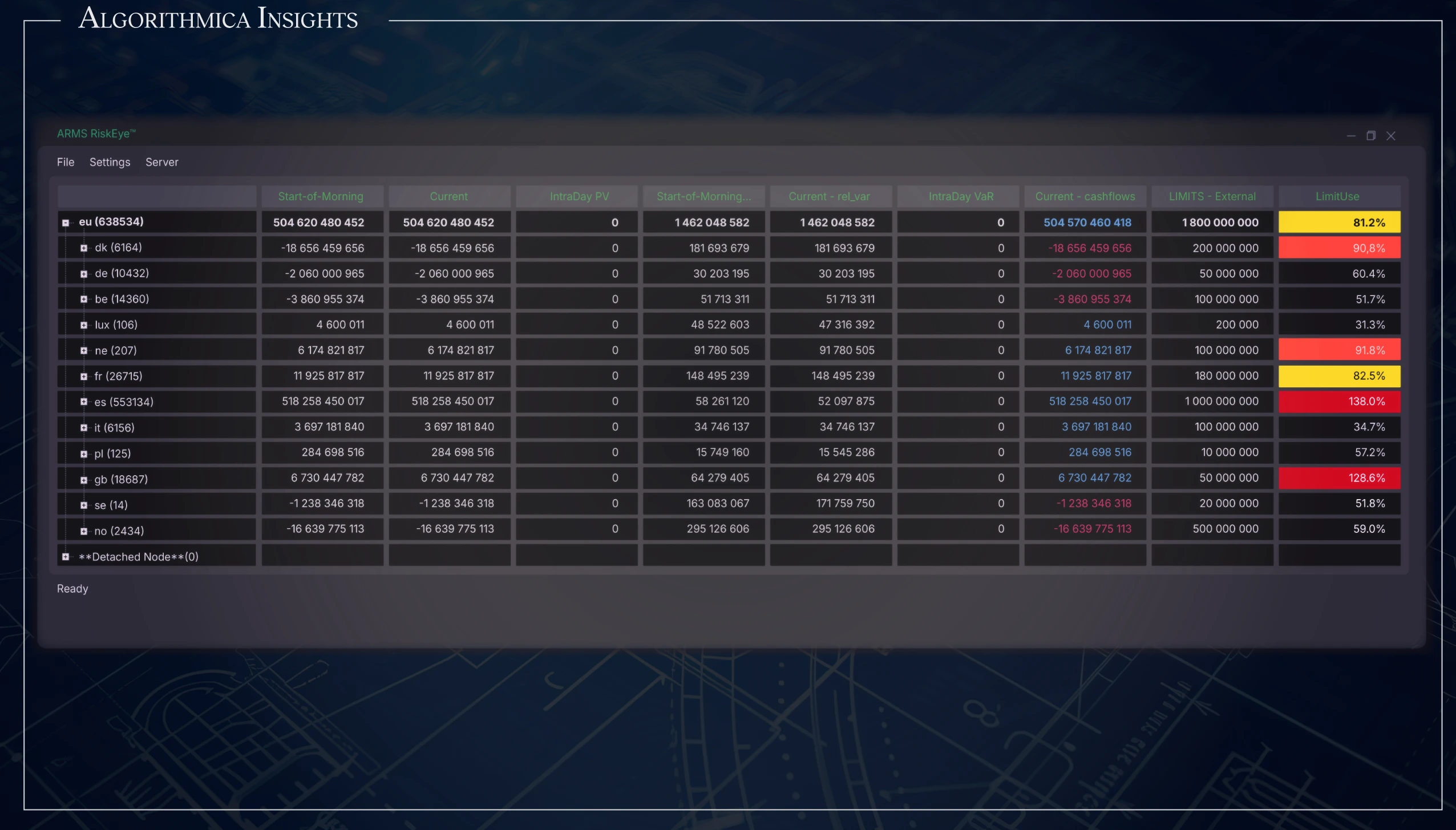
When building a system capable of real-time intraday risk analysis across more than two million positions, adding hardware was never the decisive factor. The real challenge was ensuring that pricing and risk operated on consistent inputs, and that data moved through the system along well-defined, deterministic paths.
Architectural integration enables continuous simulation
By tightly integrating the calculation engine with the aggregation layer, it becomes possible to support continuous “what-if” simulations without introducing:
- latency spikes
- inconsistencies in underlying data
This is essential for any system aiming to deliver stable real-time risk.
Consistency matters more than peak performance
The result is not just a fast system, but a predictable one.
It behaves consistently under stress. Not fast only in ideal conditions, but reliably fast across the full distribution of outcomes.
Good system design outperforms brute force
Throwing hardware at the problem rarely solves the underlying issue.
In real-time trading systems, good design is faster than brute force.